1. Product Description
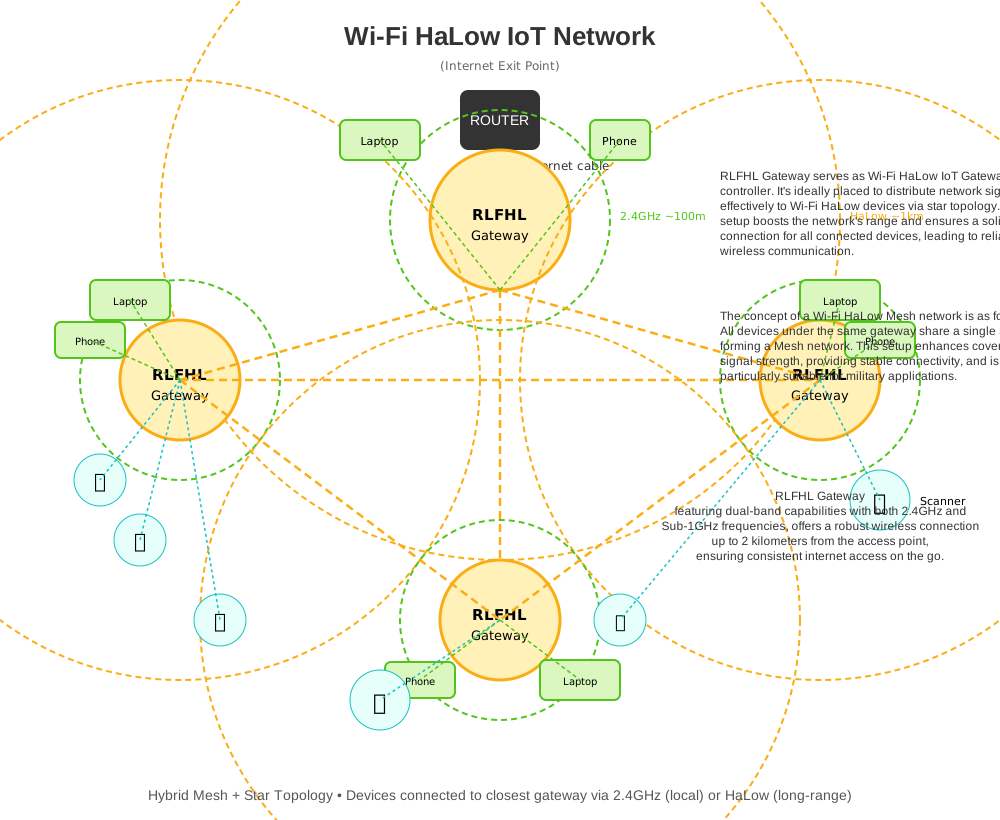
RLFHL is a portable Wi-Fi HaLow ( IEEE802.11ah) mesh network providing secure IP transport for messages, telemetry, images, and opportunistic video. The system is designed to operate where traditional tactical radios and centralized command networks fail.
RLFHL prioritizes survivability, simplicity, and manufacturability over peak throughput. It deliberately avoids proprietary waveforms and closed ecosystems in favor of open standards and crypto agility.
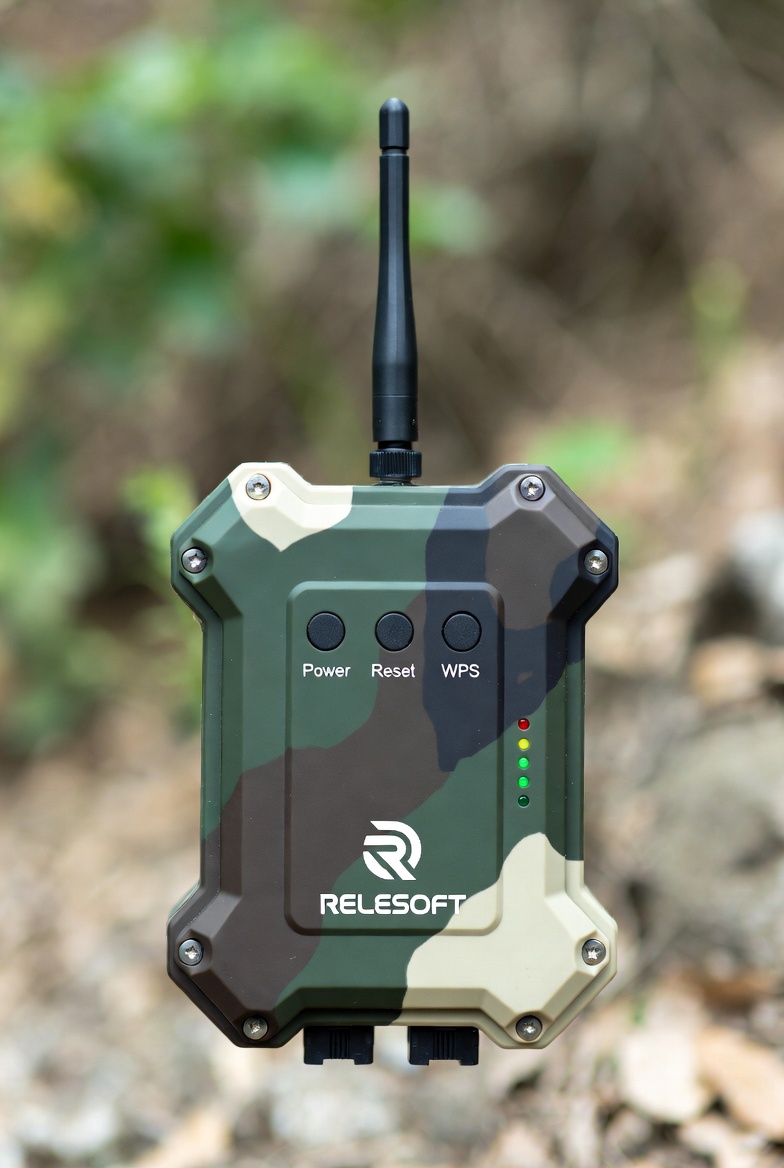
RLFHL Tactical Wi-Fi HaLow MESH Network
Combining portable gateway mobility with robust access point capabilities
Portable Gateway Features (RLFHL-UM)
- Plug-and-Play, Zero Configuration:No setup required, offering immediate access to wireless internet.
- Energy Efficiency:Wi-Fi HaLow ensures low power consumption, excellent signal penetration, and energy efficiency, all while reducing costs and environmental impact.
- USB Power Bank Support:A wearable, convenient solution. A standard power bank can keep the RLFHL operational for up to 8 hours.
- Seamless On-the-Go Connectivity:Lightweight, convenient wearable devices, combined with WiFi HaLow's long-range connectivity, provide wireless networking anytime, anywhere.
Access Point Features (RLFHL-AP)
- Versatile Connectivity:Offers diverse connectivity options, eliminating the need for unnecessary hubs. Customize and expand your wireless network with unparalleled flexibility.
- High Device Capacity:Supports over 8,000 stable connections, four times the capacity of traditional Wi-Fi access points, thanks to innovative star network topology.
- Long-Range Communication:Pushes Wi-Fi boundaries, extending connectivity farther than ever before, exceeding 1 km per hop.
- Robust Data Transmission:Achieves reliable 150Kbps data rates for distances over 1 kilometer, coupled with high-speed video streaming capabilities for shorter ranges.
- Exceptional Signal Penetration:Excels in cutting through barriers, providing tenfold improved signal penetration compared to standard Wi-Fi frequencies, ensuring strong and consistent connectivity.
Graceful Degradation
Maintains command connectivity even when bandwidth drops to 150 kbps under EWpressure.
Attrition Tolerant
Network survives loss of 30-40% of nodes through self-healing mesh topology.
Low Observability
Sub-1GHz, adaptive duty cycle reduces RF signature by 60-80% vs typical tactical radios.
Technical Summary
| Parameter | Specification |
|---|---|
| Frequency | Sub-1 GHz regional bands (863-868 MHz EU, 902-928 MHz US) |
| Range | >1 km per hop (terrain dependent) |
| Throughput | 150 kbps – 86.7 Mbps (adaptive) |
| Topology | Self-forming mesh, optional backbone |
| Security | WPA3+ hybrid PQkey exchange |
| Power | 7-10 days active, 2+ year standby |
| Interoperability | Standard IP (IPv4/IPv6), Ethernet, USB-C |
| Environmental | MIL-STD-810G (shock, vibe, temp, humidity) |
2. Doctrine-Aligned Use Cases
Forward / Remote Sites
- Establishes local wireless backbone connecting sensors, cameras, and command terminals
- Operates where no backhaul exists or infrastructure is degraded
- Supports ISRdata exfiltration from denied areas
- Optional integration with satellite solutions like Starlink for hybrid backhaul to wider IP networks
Mobile Teams and Assets
- Wearable or vehicle-mounted RLFHL-UM nodes extend mesh dynamically
- Maintains message and image flow as teams move through terrain
- Blue-force tracking via low-rate telemetry ( NMEAformat)
Temporary Operations
- Rapid deployment for exercises or disaster response
- No permanent spectrum or infrastructure commitments required
- Company-level setup in under 20 minutes
3. Problem Analysis & Solution Matrix
| Observed Problem | Typical Military Systems | RLFHL Solution Direction | Operational Impact |
|---|---|---|---|
| Centralized nodes destroyed | Star topology collapses catastrophically | Fully distributed mesh, no single point of failure | Partial functionality survives node loss |
| EWdetection and targeting | Constant beacons, high RFsignature | Adaptive duty cycle, low-power sub-GHz operation | Reduced detectability by 60-80% |
| High logistics burden | Short battery life, proprietary spares | Low power design, COTScomponents, multi-day operation | Resupply interval extended from hours to days |
| Vendor lock-in | Closed waveforms, restricted devices | Open IEEE+ IP backbone, multi-vendor compatible | No single-source dependency, competitive pricing |
| Training overhead | Weeks of signal training required | Hours-level operator training (IP networking basics) | Faster deployment, lower skill threshold |
| Crypto obsolescence risk | Fixed algorithms, hardware-dependent | Crypto-agile, post-quantum ready via software update | Future-proof against quantum decryption threats |
| Complexity in stress | High cognitive load, multiple systems | Single system for data, self-forming network | Reduced operator error under fire |
| Satellite dependency | Over-reliance on systems like Starlink exposes vulnerabilities to orbital threats, jamming, or terminal targeting | Ground-based, low-signature mesh provides independent, attritable redundancy; can integrate Starlink or other satellites as additional routes to wider IP networks without pure reliance | Maintains tactical connectivity in denial scenarios while leveraging satellites opportunistically |
4. Direct Competitive Comparison
| Parameter | Typical Tactical SDR(e.g., Bittium Tough) | RLFHL Approach | RLFHL Advantage for Attrition Warfare |
|---|---|---|---|
| Unit Cost | High (thousands EUR) | Low (hundreds EUR) | Economically attritable. Enables mass deployment and reserve stockpiles. |
| Waveform | Proprietary, vendor-locked | Open IEEE 802.11ah standard | No vendor lock-in. Enables multi-vendor sourcing and custom development. |
| Network Model | Often point-to-point or star | Self-healing distributed mesh | No single point of failure. Survives multiple node losses. |
| RFSignature | High (powerful, often UHF+) | Low (sub-1GHz, adaptive duty cycle) | Lower EW/ ELINTdetectability. Harder to target with direction finding. |
| Primary Use | Voice, Data (replacing legacy radios) | Data Backbone(messaging, telemetry, ISR ) | Complementsvoice radios with resilient IP data layer. |
| Logistics | Specialized batteries, complex training | COTSbatteries, simple IP training | Simpler sustainment, easier operator training, commercial supply chain. |
| Failure Mode | Catastrophic (gateway loss = network loss) | Graceful degradation | Partial functionality maintainedeven under heavy attrition. |
5. Total Ownership Cost & Support
Cost Breakdown
| Cost Component | Estimate (EUR) | Notes |
|---|---|---|
| Unit Procurement Cost (RLFHL-AP) | < 200 | Volume of 1,000+ units |
| 5-Year Sustainment (per unit) | 80-120 | Includes spares, updates, support |
| Initial Training Package | 5,000 | Train-the-trainer for up to 50 units |
| Annual Support Contract | 15% of hardware | Optional extended firmware/security updates |
Training Requirements
- Operator Course:4 hours (basic deployment, diagnostics)
- Maintainer Course:2 days (node replacement, configuration)
- Training Materials:Provided in local language (PDF, video)
Warranty & Support
- Standard Warranty:2 years (parts and labor)
- Extended Support:Available up to 10 years post-procurement
- Update Policy:Security updates for 5+ years, critical bug fixes for 10+
- Depot Repair:Turnaround < 14 days, 70% cost savings vs new unit
6. Integration & Interoperability
Physical Interfaces
- Ethernet (PoEcapable) for command post integration
- USB-C for power/data (field tablets, battery packs)
- Optional SMA connectors for external directional antennas
- Standard NATObattery connectors (compatible with BA-5590 etc.)
Gateway Functions
- RLFHL-AP provides Ethernet bridge to tactical LAN
- Concurrent 2.4/5 GHz Wi-Fi for local device connectivity
- Protocol translation for legacy systems (serial-to-IP)
- Store-and-forward for delay-tolerant networking
- Integration with satellite terminals (e.g., Starlink) as additional routes to wider IP networks for hybrid connectivity
Standards Compliance
- Data Formats: NMEAfor tracking, MJPEG/H.264 for video, REST APIfor C2
- Routing:Standard IP routing ( OSPF , BGP) for backbone integration
- Security: FIPS140-2 validated crypto modules, CSfCcompliant architecture
- VICTORY Alignment:Data bus compatible, standard service definitions
7. Test & Evaluation Summary
Field Test Results
| Test Scenario | Range Achieved | Avg. Throughput | Packet Loss | Notes |
|---|---|---|---|---|
| Wooded Terrain | 1.2 km | 4.8 Mbps | < 1% | 2 nodes, line-of-sight obstructed |
| Urban, Non-LOS | 400 m | 1.1 Mbps | 5% | 3-hop mesh around buildings |
| EWEnvironment | N/A | Adaptive (150 kbps min) | 15% peak | Maintained command channel under broadband noise |
| Extended Endurance | Consistent | Stable | < 2% | 7-day continuous operation, battery |
Certification Status
- Environmental: MIL-STD-810G testing completed (shock, vibration, temperature)
- EMC: MIL-STD-461 compliance in progress
- Security:Targeting NIAP /Common Criteria evaluation, CSfC component listed
- Safety:CE, FCC marked for commercial bands
Operational Testing
- Field trials with partner military units (Fall 2023)
- Contested RFenvironment testing at national EWrange
- Interoperability testing with [Redacted] C2 system
8. Risk Mitigation
Identified Risks & Mitigations
| Risk | Probability | Impact | Mitigation Strategy |
|---|---|---|---|
| Spectrum congestion/jamming | Medium | High | Adaptive frequency hopping, fallback to most robust modulation, low duty cycle operation |
| Supply chain disruption | Medium | Medium | Dual-source critical components, firmware adaptable to alternate HaLow SoCs |
| Mesh protocol instability | Low | High | Battle-tested OLSR/ B.A.T.M.A.N. adaptation, field-tested with 50+ node density |
| Crypto vulnerability discovery | Low | Critical | Crypto-agile architecture, ability to update algorithms without hardware replacement |
| Integration complexity | Medium | Medium | Standard IP interfaces, published APIdocumentation, reference integration kits |
| Satellite integration risks | Medium | Medium | Support for hybrid routing with satellites like Starlink as opportunistic backhaul; core mesh operates independently to avoid over-reliance and associated vulnerabilities (e.g., jamming or targeting) |
Contingency Plans
- Alternative Frequencies:Design supports migration to other sub-GHz bands if primary bands become unusable
- Fallback Mode:Ultra-low rate (150 kbps) "beacon" mode maintains basic connectivity under extreme EW
- Legacy Integration:Gateway can interface with traditional tactical radios as emergency backhaul
- Satellite Fallback:While integrating satellites enhances reach, RLFHL ensures ground-based resilience to mitigate risks of pure satellite dependency
9. Network Topology Overview